Upgrading Vehicle Testing
Upgrading Vehicle Testing
From paper manuals to a digital guide
From paper manuals to a digital guide

Mobile App
Mobile App
Context
Vehicle manufacturers rely on test driving as a core part of safety and quality assurance. A test drive tasks a driver with evaluating a car’s performance while following a predefined sequence of actions (referred to as cycles) on a controlled environment such as a test track.
These workflows are typically supported by extensive paper-based documentation — often binders of up to 100 pages — requiring drivers to flip through instructions while executing tests and later transfer results manually into digital systems.
Our team was approached to rethink this process and turn fragmented paperwork into a single digital solution, supporting both test drivers on the field as well as engineers managing the tests.
Business Impact
By upgrading the testing workflows, we were able to:
Reduce costs by eliminating printed test binders, while decreasing the company’s environmental footprint
Save time during test execution by providing the right information at the right moment (estimated 10 min per driver per day)
Remove the need to manually input test results into spreadsheets at the end of the day
Improve data quality through instant reporting, including photos and video.
Improve access to historical test data and results
Old > New flow
Opportunity
Manuals were often long and difficult to navigate, especially for new drivers who were still learning the structure of each test cycle. At the same time, results and errors recorded on paper had to be manually transferred into spreadsheets at the end of the day, adding unnecessary steps and increasing the risk of errors.
This project focused on simplifying and structuring that experience by:
Replacing multiple paper documents with a single digital guide and record
Lowering the learning curve for new test drivers while reducing friction for experienced testers alike
Enabling engineers to track progress and results in real time
Shortening the feedback loop between test execution and iteration
Role & responsibilities
I was the sole UX designer in a cross-functional team composed of developers, product owners, and a delivery manager.
My role focused on shaping the experience from early exploration through to implementation:
Delivered a proof of concept in 1 month, iterating quickly through wireframes and live product feedback
Collaborated with engineers through implementation and testing
Conducted user interviews to gather feedback and validate design decisions
Created a mobile-first design library to support test drive usage constraints
Design Approach
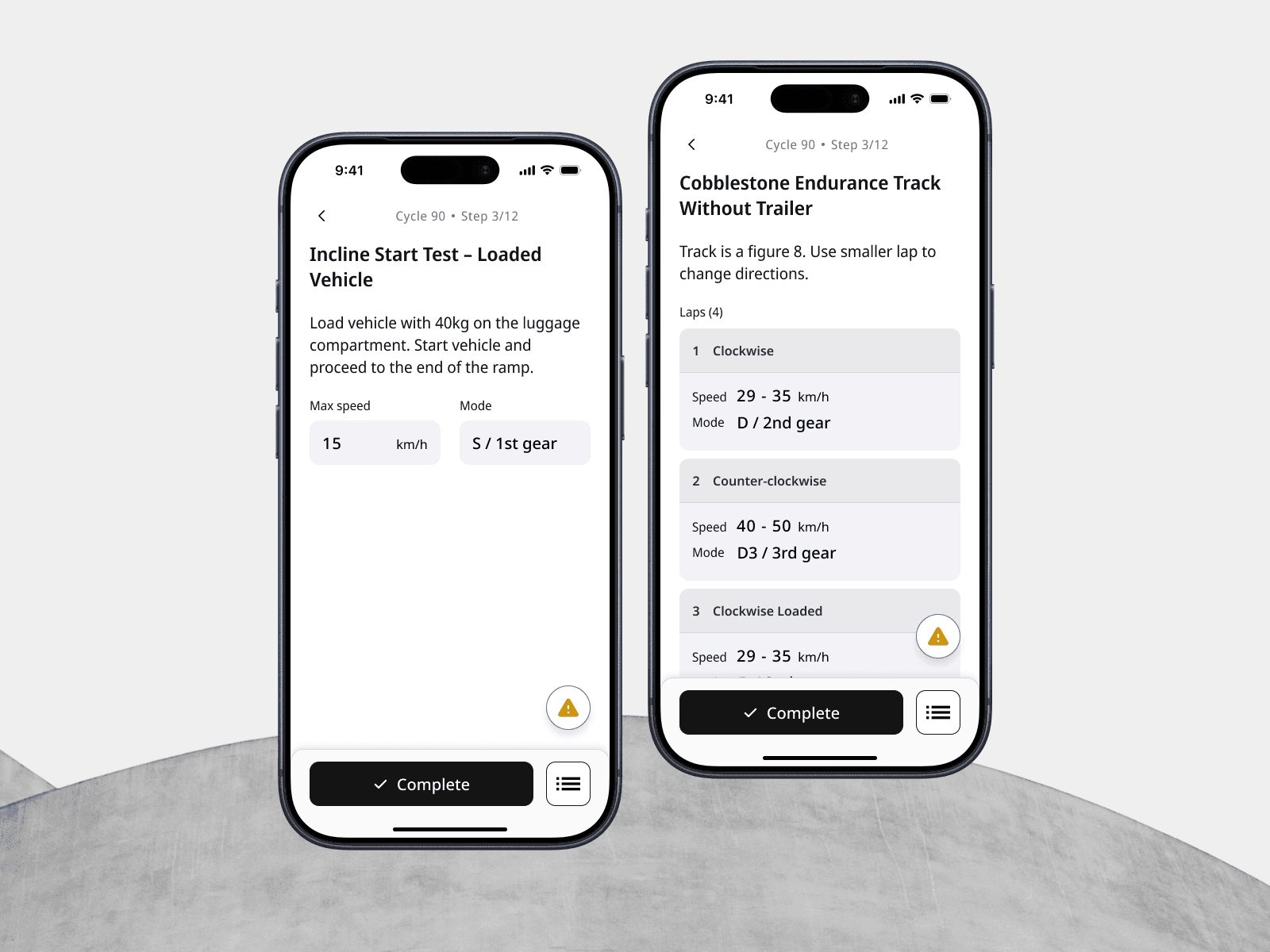
The solution combined a mobile experience for drivers with a desktop tool for test configuration and monitoring.
This meant designing both step-by-step guidance and shortcut interactions, depending on the driver’s level of experience.

Step-by-step vs cycle view
Guided Testing Flows for Beginners
Drivers were guided step-by-step through test cycles:
• Clear, sequential instructions
• Task validation and completion states
• Reduced need to reference external documentation
With the ability to see the entirety of a test in a list and complete it all at once (after completing all the steps)
Cycle overview for experienced drivers
Enable quick completion by experience testers
Replicating the feel of browsing a spreadsheet list of items and knowing what each one represents simply by reading its name
Using progressive disclosure to only show task details if needed
Providing quick actions from the cycle sheet list
Step-by-step view highlights
Designing for the Driving Context
The interface was adapted for quick interaction in a physical environment:
• Large typography and controls for readability
• High contrast and minimal UI noise
• Clear states and feedback for fast decision-making
Even when stationary, interactions needed to be quick and clear.
From Spreadsheets to Structured Input
Replaced manual data entry with structured, contextual inputs:
• Predefined fields tied to each test step
• Reduced ambiguity and human error
• More consistent and reliable data collection
Desktop view
Real-Time Visibility
Enabled engineers to monitor progress through a connected system:
Live test tracking
Status updates per cycle and task
Centralised overview of ongoing tests
Conclusion
By digitising a traditionally manual and fragmented process, this project simplified how vehicle testing is executed and managed.
By bringing instructions, execution, and reporting into a single system, drivers were able to operate with greater clarity and efficiency, while engineers gained immediate visibility into test results. Beyond improving day-to-day operations, it established a foundation for more scalable and data-driven testing processes.
Context
Vehicle manufacturers rely on test driving as a core part of safety and quality assurance. A test drive tasks a driver with evaluating a car’s performance while following a predefined sequence of actions (referred to as cycles) on a controlled environment such as a test track.
These workflows are typically supported by extensive paper-based documentation — often binders of up to 100 pages — requiring drivers to flip through instructions while executing tests and later transfer results manually into digital systems.
Our team was approached to rethink this process and turn fragmented paperwork into a single digital solution, supporting both test drivers on the field as well as engineers managing the tests.
Business Impact
By upgrading the testing workflows, we were able to:
Reduce costs by eliminating printed test binders, while decreasing the company’s environmental footprint
Save time during test execution by providing the right information at the right moment (estimated 10 min per driver per day)
Remove the need to manually input test results into spreadsheets at the end of the day
Improve data quality through instant reporting, including photos and video.
Improve access to historical test data and results
Old > New flow
Opportunity
Manuals were often long and difficult to navigate, especially for new drivers who were still learning the structure of each test cycle. At the same time, results and errors recorded on paper had to be manually transferred into spreadsheets at the end of the day, adding unnecessary steps and increasing the risk of errors.
This project focused on simplifying and structuring that experience by:
Replacing multiple paper documents with a single digital guide and record
Lowering the learning curve for new test drivers while reducing friction for experienced testers alike
Enabling engineers to track progress and results in real time
Shortening the feedback loop between test execution and iteration
Role & responsibilities
I was the sole UX designer in a cross-functional team composed of developers, product owners, and a delivery manager.
My role focused on shaping the experience from early exploration through to implementation:
Delivered a proof of concept in 1 month, iterating quickly through wireframes and live product feedback
Collaborated with engineers through implementation and testing
Conducted user interviews to gather feedback and validate design decisions
Created a mobile-first design library to support test drive usage constraints
Design Approach
The solution combined a mobile experience for drivers with a desktop tool for test configuration and monitoring.
This meant designing both step-by-step guidance and shortcut interactions, depending on the driver’s level of experience.
Step-by-step vs cycle view
Guided Testing Flows for Beginners
Drivers were guided step-by-step through test cycles:
• Clear, sequential instructions
• Task validation and completion states
• Reduced need to reference external documentation
With the ability to see the entirety of a test in a list and complete it all at once (after completing all the steps)
Cycle overview for experienced drivers
Enable quick completion by experience testers
Replicating the feel of browsing a spreadsheet list of items and knowing what each one represents simply by reading its name
Using progressive disclosure to only show task details if needed
Providing quick actions from the cycle sheet list
Step-by-step view highlights
Designing for the Driving Context
The interface was adapted for quick interaction in a physical environment:
• Large typography and controls for readability
• High contrast and minimal UI noise
• Clear states and feedback for fast decision-making
Even when stationary, interactions needed to be quick and clear.
From Spreadsheets to Structured Input
Replaced manual data entry with structured, contextual inputs:
• Predefined fields tied to each test step
• Reduced ambiguity and human error
• More consistent and reliable data collection
Desktop view
Real-Time Visibility
Enabled engineers to monitor progress through a connected system:
Live test tracking
Status updates per cycle and task
Centralised overview of ongoing tests
Conclusion
By digitising a traditionally manual and fragmented process, this project simplified how vehicle testing is executed and managed.
By bringing instructions, execution, and reporting into a single system, drivers were able to operate with greater clarity and efficiency, while engineers gained immediate visibility into test results. Beyond improving day-to-day operations, it established a foundation for more scalable and data-driven testing processes.